




Fire Retardants in Mattresses
A quick Google search for “mattress flame retardant” nets you 1.5 million search results in .40 seconds. Scroll down to get information and most articles or blogs cover the same content; since 2007 US Consumer Product Safety Commission required all mattresses to contain flame retardants, however, they forgot to require manufacturers to identify the chemicals they used. Click the news tab and you see the most current legal issues with major brands and mega-retailers. “Fiberglass a cheap alternative”, “Failure to meet fire standards” and “Made In USA” top the search and news headlines.
Did you know that due to that requirement all mattresses sold in the US are required to contain enough fire retardant chemicals to withstand a 2-foot wide blowtorch open flame for 70 seconds Nearly 92% of the market, or most major sleep product brands, use a highly controversial fire retardants due to its cost efficiency.
With so much noise and confusion, how do you know what your mattress uses for flame retardant? Is it organic or is it full of chemicals and toxins? It makes sense to have fire protection but at what cost to your health?
While researching, we found that there are hundreds of different flame retardants and understanding them all requires a Ph.D. in chemistry and biology. PBB, PBDEs, HBCDD, TDCPP, TCEP, PolyFR, TBPH, TBBPA, and the list goes on. However, we can generally group them into categories based on structure.
When shopping for a new mattress, be mindful of these words: bromine, chlorine, phosphorus, nitrogen, metals, and borons. If you see them listed, run… FAST! The mattress industry is listening to its consumers and many brands are offering organic solutions to provide healthier and safer fire protection but complete transparency is still lacking. The adage “you get what you pay for” really applies when comparing cheap memory foam to high-end organic mattresses.
How Do You Get Exposed to Fire Retardants
So how are we exposed to flame retardants? Skin contact, inhalation, and ingestion.
We don’t see it or feel it but prolonged exposure has been documented to have adverse effects on your health. This is more evident for adults and children with compromised immune systems or other health complications. We sleep 7-8 hours a day and have our nose and mouth very near the mattress surface so any airborne particles will likely be inhaled.
Other things to consider:
- Escaped chemicals can get into the air, water, and soil during production.
- Mattress VOCs leak into the surrounding atmosphere and dust particles.
- Dust can get on hands and food and then be consumed.
- Pets will experience the same exposure and risk.
It is not just the mattress material you consider but also the additives used to combine with petroleum based foams to make them fireproof. These ingredients are not usually listed on labels or manufacturer’s websites, so ask the right questions to get the right answers. If you value your health, do the research and evaluate your sleep priorities and needs. Find out what is best for your situation and make the investment for healthy sleep. One shoe size doesn’t fit all and one mattress is not made for everyone.
Fire Retardants are prevalent in a multitude of common household products and can be found in everything from pillows to couches, children's clothing, carpets, computers and baby toys.
Hazardous Chemicals & Additives Found in Fire Retardants:
-
Ozone depleters are gaseous compounds such as chlorofluorocarbon (CFC) that are harmful to the planet and human health.
-
Mercury, lead, and other heavy metals are often added to foam during manufacturing. These additives are linked to kidney and brain damage, as well as digestive problems.
-
Phthalates are industrial chemicals used to soften polyvinyl (PVC). They have been shown to cause reproductive complications, kidney, and liver dysfunction.
- Pesticides pose a serious health risk. Many of the pesticides used on cotton, which is a common mattress material, have been linked to cancer and organ failure with long-term exposure.
-
Benzene is often used in plastics, dyes, detergents, glues, and pesticides. However, it is a dangerous chemical that has been shown to reduce bone marrow function and red blood cell counts. Both of these side effects can decrease our immune function and make it difficult to fight infection.
-
Toluene is often present in industrial adhesives. According to the Occupational Safety and Health Administration(OSHA) it causes nausea, headaches, and dizziness if inhaled.
-
Boric Acid is used as a pesticide and is linked to reproductive and developmental toxins.
-
Antimony is a possible carcinogen and may cause heart and lung damage.
- Decabromodiphenyl Oxide is another possible carcinogen that causes hair and memory loss.
These are just a sampling of the chemicals and additives that can leech through mattress covers and are absorbed through the skin.
Exposure to Flame Retardants (FRs) Has Been Linked To:
- Skin irritation
- Learning and memory deficit
- Cancers
- Heart, lung, and kidney damage
- Birth defects
Chronic exposure to these chemicals causes them to accumulate in the body and present themselves in your bloodstream, breast milk, and even umbilical cord blood.
The U.S. Consumer Products Safety Commission (CPSC) approved a 2006 federal regulation (16 CFR 1640) enforcing a strict national flameproof mattress standard, mandating all new mattresses to withstand a two-foot wide blowtorch open flame test, for 70 seconds.
The national flameproof mattress regulation has been in effect in California since 1/1/05 and is now effective nationwide. All mattresses, sofa beds, futons, cribs and fold out beds are included under the regulation.
Fire Retardants are prevalent in a multitude of common household products and can be found in everything from pillows to couches, children's clothing, carpets, computers, and baby toys.
Why are Most Mattresses Fire Retardants Harmful?
Though the new regulation is intended to provide fire safety, it has produced a new health risk due to the use of the hazardous chemical composition of most flame retardants.
Most major mattress brands treat their sleep products with hazardous fire retardants in order to acquire the anti-flammable property necessary to withstand the two-foot thick open flame blowtorch test.
The regulation does not mandate the labeling of chemicals used in fireproofing; manufacturers are free to use any and all chemicals including those that have yet to be tested for hazardous side effects.
Ironically, the National Flameproof Mattress regulation in the US allows physicians, including chiropractors, to prescribe fire retardant-free mattresses for patients should they conclude that the health risks posed by toxic fire retardants will interfere with the patient's well-being.
The requirement for a Flame Proof mattress is only applicable in the United States. Here at Essentia we manufacture our mattresses in our GOLS and GOTS certified organic factory in Canada. As Canada does not have the same regulation in place as the US, all mattresses that we ship within Canada do not have the non-toxic Kevlar flame retardant fabric.
This also means here at Essentia we are happy to ship a mattress to our customers in the US without that Kevlar fabric sock if we are provided a prescription from a doctor stating that you require a mattress without a flame retardant.
Natural & Non-Toxic Fire Retardant Options
When shopping for a new mattress there are some options for natural and nontoxic materials for fire protection.
-
Wool is naturally fire-resistant and in most cases does not need to be treated with chemicals however the wool density required to pass the open flame tests is too compacted for comfort. In most cases, the wool is backed with a chemical-laced batting in order to meet legal requirements. Also to be considered is any batting including wool used as a top surface comfort layer introduces allergens, dust mites, and bed bugs.
-
Natural Latex is another material that is fire-resistant without chemicals. Make sure your latex is not a blend or mix, it must be from Hevea milk and GOLS certified to limit your exposure to toxins and VOCs.
-
Rayon a textile made from cellulose fiber bonded to silica is an option however it is not completely natural or environmentally friendly. It is free from dangerous chemicals such as those found in flame retardants.
- Kevlar is a synthetic material made of durable plastic fibers that are fire-resistant. This material is not treated with any harmful chemicals, is non-toxic, and is safe for human contact. While being the most expensive option, it does test to be inert and does not introduce any harmful chemicals or particles into your sleep environment.
Choosing a Healthier Mattress
As more people prioritize their sleep, the options for healthy and safe mattresses will become mainstream. The use of flame retardant chemicals is a poor choice for us and our planet. This means it will be even more important for you to seek a mattress that is free of toxic chemicals and made with only natural ingredients.
Essentia Mattresses are the foundation of healthy sleep. With our GOLS and GOTS certification, all Essentia mattresses are truly organic and hypoallergenic which means no exposure to VOCs, and are impervious to bed bugs and dust mites. If you are looking for more comfort, support and performance you’ll like our Lifestyle and Performance mattress collections.
We, Essentia, have also opted to incorporate a better quality fire retardant in all our mattresses.
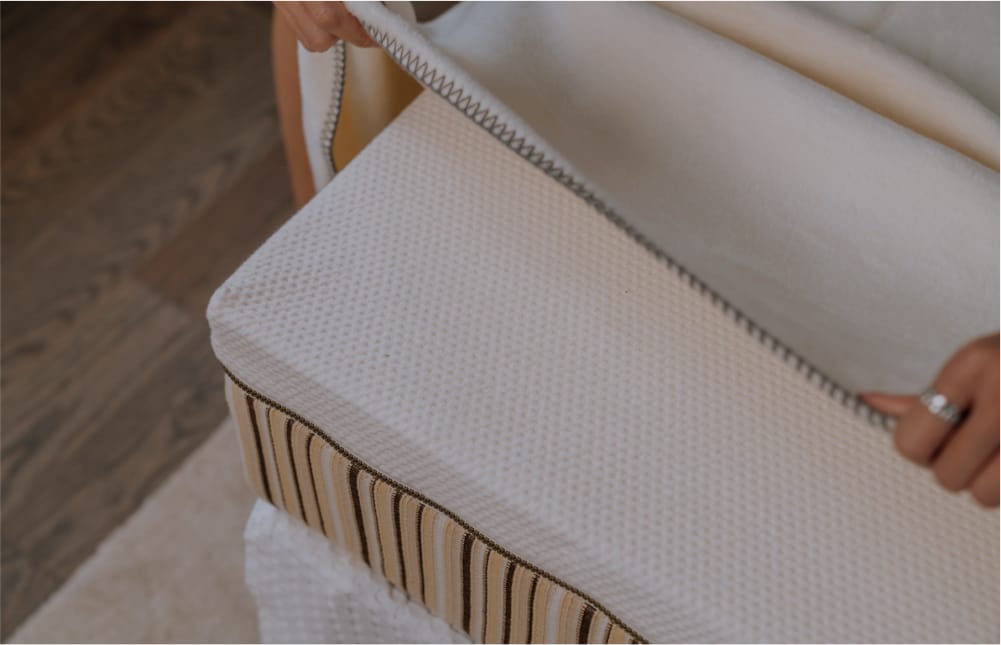
By using Kevlar, the same fabric used in bulletproof vests, Essentia organic latex foam mattresses, and organic crib mattresses meet all safety standards without compromising our product integrity and commitment to a healthier night's sleep. Since Kevlar is a fabric, we put it on the mattress much like a sock and sew it up on the other end. This means we don’t spray any harsh chemicals or toxic flame retardant chemicals in our GOLS and GOTS certified organic factory.

