




How many options is too much choice?
The fact is that having too many options can overwhelm you because you’re not quite sure about the differences between each option.
That’s how you feel when you attempt to find the right mattress for you. Unlike many other purchases, mattresses are subjective because each person’s body and sleep needs are different.
Today, there are many different mattress “types” marketed to sleepers. Manufacturers like to introduce confusing abbreviations or labels to make their product seem unique — but that’s not helpful when shopping for a mattress.
It’s time to cut through the jargon.
In this article, we will break down the differences between a spring mattress vs. memory foam mattress. We’ll look at the benefits of each, what you need to watch out for, and where each type of mattress ranks for factors like comfort, support, and hypoallergenic materials.
What is a Spring Mattress
Today, a spring mattress is the “standard” mattress. Rewind to the middle of the 19th century, and it was a novelty. Heinrich Westphal designed the first modern-day spring mattress. He repurposed the coil spring invention used for chairs and wrapped rows of them in an iron frame.
At this time, manufacturers used raw cotton, hair, wool, or feathers as stuffing in the mattress’s encasement, with a frame of tightly-wound, uniform steel spring coils.
However, these natural materials collect vermin and mildew, especially in warmer states across the United States. Manufacturers changed their production process and some materials to make sure their spring mattresses were sanitary.
During the 1940s and 50’s these types of mattresses occupied a space in almost every home across the country. They would remain unchallenged until the 1970s and 80’s, when waterbeds and memory foam mattresses became viable alternatives.
There are several types of spring mattresses available on the market today.

-
Open or Bonnell Coils are are hourglass-shaped and laced together to give uniformity of reaction. A rod is used to add strength to the perimeter of the mattress. Open coil mattresses typically don’t feature firmness zones for spinal alignment and aren’t as good at reducing motion transfer. Bonnell springs are similar to open coils except they use a helix of wire to connect the springs.
-
Pocketed or Encased Coil, very popular today, these are individually encased in a fabric to act independently of each other. This design allows targeted support and offers a balance between feel and comfort and you can tailor the springs to suit your body weight. Many offer a comfort layer for a more luxurious feel.
-
Offset Coils are similar to Bonnell, however, they have a square head design flex like a hinge when compressed, and provide better contour characteristics. In addition, they have one straight side to lace more closely together.
- Continuous Coils use one single length of wire that is weaved into many different interwoven springs that usually run up and down the length of the mattress with a vertical linking system. Typically not good for individual support however they provide durability, and consistency and are the least expensive.
You can still buy an open coil innerspring mattress today, but they’re usually very cheap, and they break down quickly. They offer no pressure relief and will also start to creak and sag in no time. This is why people who prefer an innerspring system always choose pocket coil springs as a standard.
Pros of a Spring Mattress
- Are priced lower than memory foam mattresses
- Responsive with a little bounce.
- More supportive than foam, especially for heavier people.
- Customizable firmness based on support needs or weight is possible.
- Pocketed coils create less motion transfer and won’t trap body heat.
Cons of a Spring Mattress
- Despite a comfort layer, spring mattresses will start to sag rapidly. Many innerspring systems lose up to 16% of their “bounce” in the first year alone.
- There is a lack of contouring, which means less back support since the materials aren’t moldable to your body. You could experience the onset of back pain faster.
- It cannot offer sufficient pressure relief, which means sleepers often wake up with aching joints, pressure points. This also causes numb arms due to poor blood circulation.

The red areas are significant because it means the spring mattress is pushing back against your body, rather than absorbing your body’s weight. Some areas of your body will push down harder than others, which means that you won’t be able to experience even support as you sleep.
This is also why you sometimes wake up with a sore shoulder or a stiff lower back when sleeping on an older spring mattress.
What is a Memory Foam Mattress?
Somehow, mattress material innovation is something only astronomers work on. Heinrich Westphal was a German astronomer. Similarly, memory foam mattresses came about in 1966 through Charles Yoast's work. He happened to be an American space engineer under contract for NASA.
It began as “temper foam,” and the whole point was to improve seat cushioning and crash protection for airline pilots and passengers. That tells consumers a significant fact: memory foam is designed for motion and shock absorption, and to protect the body from impact.
Today, memory foam mattresses offer superior comfort and pressure point support. Many of them are designed to align the spine for side sleepers, stomach sleepers, and back sleepers.
In fact, they’re so popular that those who are more familiar with innerspring systems will often opt for a hybrid mattress. This allows sleepers to experience the therapeutic benefits of a memory foam mattress through a spring mattress construction. It’s the best of both worlds.

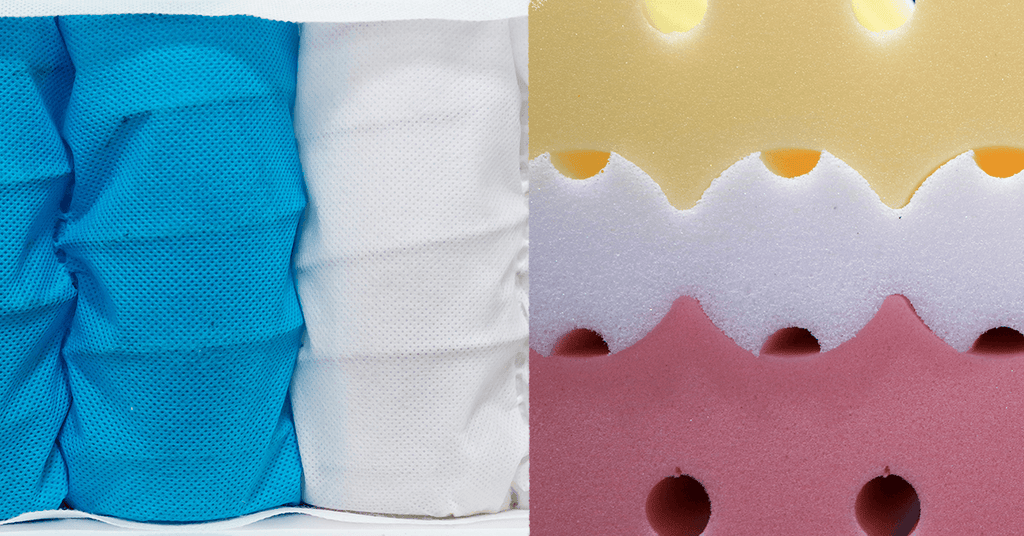
Now, there is a lot of confusion about memory foam mattresses because there are quite a few types of foam materials incorporated into the construction of these mattresses. Some manufacturers use uniform foam materials, while others use a combination. With an innerspring mattress, the frame is always a set of pocketed or open coils.
But, as you can see, memory foam mattresses include several different foam layers for a truly customized sleep experience. Beyond this, you can also opt to change the density, firmness levels, and contouring of a new mattress.
To help you understand the difference between the different types of foam mattresses available, use this handy comparison chart. You’ll see that not all memory foam mattresses are created the same, even if they’re called “memory foam.”
You can opt for latex, polyurethane, gel, or combinations of these layers, based on your budget and sleep needs.

The pros and cons of memory foam mattresses relate to the use of these materials. There is a type of memory foam that addresses the “cons” of a latex or foam mattress -- and it’s used in all Essentia mattresses.
Pros of a Memory Foam Mattress
- Scientifically proven to prevent back pain by supporting the natural spinal alignment
- Provides adequate pressure point support
- Distributes body weight evenly
- Absorbs the weight of a sleeper in a way that promotes more restful and restorative sleep
- Dust mites cannot enter into the dense material or the layers of the memory foam mattress
- Improves blood pressure and circulation
Cons of a Memory Foam Mattress
- Can be hot, due to density, which is why some manufacturers will use gel for a cooling effect
- Can take a while to conform to the body’s specific curves and pressure points because it’s so durable
- Use of artificial or synthetic materials in foam construction
- Polyurethane foam can be toxic to health, based on how it’s produced
- Most foams release an unpleasant smell during the initial setup and can last up to weeks or even months. This is toxic off-gassing.
The one type of memory foam that counteracts many of these disadvantages is natural memory foam.
Despite its many therapeutic benefits, it’s hard to find a memory foam mattress that is also eco-friendly. For quite a while, sleepers had to choose whether they wanted a good night’s sleep, health-safe materials, a cooler, comfortable sleep surface, or hypoallergenic mattresses.
Natural memory foam mattresses transform all these concerns, providing a safe bed-in-a-box alternative to many memory foam mattresses that off-gas. Essentia offers the only mattresses that are made of it's patented slow response organic latex foam called Beyond Latex:
- GOLS and GOTS certified (for organic mattress ratings)
- Crafted using hevea milk
- Vegan
- Allergen-free
- Decreases body heat by maintaining cooling between five and nine degrees less than room temperature
- Do not release any toxic gases
- Can offer a 20-year warranty as natural memory foam loses less than a quarter of an inch of its original height after 10 years of use
Spring Mattress vs. Memory Foam Mattress — Which Wins?
Now that you know the essential differences between a spring mattress and a memory foam, it’s time to test which type of mattress can offer the best sleep.
Your personal experience on each mattress type is what matters most. However, you need to keep in mind that it’s not just about that first sleep. It’s also about all the nights of restful sleep after that first night, and how well your mattress supports your body over time.
Let’s take a look at four factors that will help you choose between a spring mattress and a memory foam mattress.
1) Temperature
Traditionally, innerspring mattresses have a clear advantage over memory foam mattresses when it comes to body temperature. Those who sleep hot may prefer spring mattresses. The coils allow air to flow freely through the mattress.
However, natural cooling changes through the years for spring mattresses. The accumulation of dust, allergens, and dead skin cells adds density to the coil spring mattress.
2) Support
When it comes to back support and pressure point support, memory foam mattresses win out every time. The materials used provide unparalleled support and pressure relief.
That’s not to say that innerspring systems can’t offer support. However, even pocketed coils wear out much faster and tend to sag in a few years.
One good option for sleepers is using a hybrid mattress. For example, the Tatami Hybrid uses the patented natural memory foam in layers, over an organic latex foam layer. However, it also packs in an eight-inch pocketed coil “support” core.

3) Longevity
You can always determine the longevity or durability of a mattress based on the manufacturer's warranty. They know how long their mattresses are supposed to last, so they’ll typically offer a warranty that runs out two years before the mattress is simply unusable.
Many spring mattresses come with a seven- to 10-year warranty, which tells you that you can expect to start seeing serious wear and tear by the three- to seven-year mark. Memory foam mattresses have a much longer lifespan because they’re made to absorb the force of your body’s weight.
4) Motion Transfer
Both spring mattresses and memory foam mattresses are good at eliminating motion transfer if you move around while sleeping. However, you have to rely on a high pocketed or individually encased coil count to experience true motion isolation for a spring mattress.
A memory foam mattress that claims to have motion transfer reduction can be just as effective as a pocketed innerspring system because it absorbs movement. However, these memory foam mattresses might be too soft, so make sure you can customize the firmness levels. The ideal firmness for back pain is medium-firm support.
Conclusion
While scientists are still studying the phenomenon of sleep, the mysteries of mattresses shouldn’t get in the way of truly restorative sleep. At Essentia, we believe that both foam and spring mattresses have their perks — but you should never have to choose between your health and a mattress’s comfort and . Essentia offers a variety of mattress types, including hybrid mattresses and all foam mattresses, so you can find exactly what you’re looking for.
That’s why we build each of our mattresses using the world’s only natural memory foam material. Over 19 years of innovation, we’ve thoughtfully designed each mattress style to conform to your goals for a good night’s sleep. Learn more about Essentia’s world-class memory foam mattress collections today.

